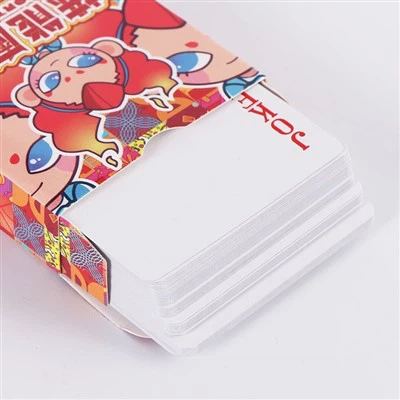

Learning cards are a powerful tool for self - improvement, offering a convenient and effective way to enhance knowledge, skills, and memory. As a learning cards supplier, I am excited to share some insights on how to make learning cards that can truly support your journey of self - enhancement.
Understanding the Purpose of Learning Cards
Before diving into the process of making learning cards, it's crucial to understand their purpose. Learning cards can be used for various reasons, such as learning a new language, memorizing historical facts, mastering mathematical formulas, or improving vocabulary. By clearly defining your goal, you can tailor your learning cards to meet your specific needs.
For instance, if you are learning a foreign language, your cards might focus on vocabulary, grammar rules, and pronunciation. On the other hand, if you are studying for a history exam, your cards could contain important dates, events, and key figures.
Choosing the Right Materials
The materials you choose for your learning cards can significantly impact their effectiveness. There are several options available, including paper, cardboard, and plastic.
- Paper: Paper is a cost - effective and easily accessible option. You can use regular printer paper or index cards. However, paper cards may be less durable and can get damaged easily.
- Cardboard: Cardboard is more sturdy than paper and can withstand more wear and tear. It provides a solid base for writing or printing information. You can find pre - cut cardboard cards at office supply stores.
- Plastic: Plastic cards are the most durable option. They are waterproof and resistant to damage, making them ideal for long - term use. You can purchase plastic card blanks and print on them using a special printer.
Designing the Content
The content of your learning cards should be clear, concise, and well - organized. Here are some tips for designing effective content:
- Keep it simple: Avoid overcrowding your cards with too much information. Each card should focus on one main idea or concept.
- Use visual aids: Incorporate images, diagrams, or charts to make your cards more engaging and easier to understand. For example, if you are making animal learning cards, include pictures of the animals. Animal Learning Cards can be a great source of inspiration for visual - based learning.
- Include questions and answers: If you are using the cards for self - testing, write a question on one side and the answer on the other. This will help you actively engage with the material and improve your retention.
- Use color coding: Color coding can help you categorize your cards and make them easier to navigate. For example, you could use different colors for different topics or levels of difficulty.
Formatting the Cards
The format of your learning cards can also affect their usability. Here are some formatting tips:
- Choose an appropriate size: The size of your cards should be convenient for you to hold and carry around. Common sizes include 3x5 inches and 4x6 inches.
- Use a legible font: Select a font that is easy to read, even from a short distance. Avoid using fancy or decorative fonts that may be difficult to decipher.
- Leave enough space: Make sure there is enough space on each card for writing or printing. This will prevent the text from looking cramped and make the cards more visually appealing.
Printing and Assembling the Cards
Once you have designed your cards, it's time to print and assemble them.
- Printing: If you are using paper or cardboard, you can print your cards at home using a printer. Make sure to use high - quality paper to ensure clear and sharp printing. If you are using plastic cards, you may need to use a special printer or send them to a professional printing service.
- Cutting: After printing, carefully cut out the cards using scissors or a paper cutter. Make sure to cut them as evenly as possible to ensure a professional look.
- Laminating (optional): If you want to make your cards more durable, you can laminate them. Laminating will protect the cards from moisture, dirt, and wear. You can use a laminating machine at home or take them to a professional laminating service.
Using Learning Cards for Self - Improvement
Now that you have made your learning cards, it's time to put them to use. Here are some tips for using learning cards effectively:


- Review regularly: Set aside a specific time each day to review your learning cards. Consistent review is key to retaining information.
- Use different techniques: There are several techniques you can use to study your cards, such as flashcard drills, spaced repetition, and mnemonic devices. Experiment with different methods to find what works best for you.
- Test yourself: Use your cards to test your knowledge. Cover the answer side and try to recall the information on the other side. This will help you identify areas where you need more practice.
- Share with others: If you are learning with a group or a study partner, share your cards and quiz each other. This can make the learning process more fun and engaging.
Our Learning Cards Offerings
As a learning cards supplier, we offer a wide range of high - quality learning cards to meet your diverse needs. Our Colourful Flash Cards are designed to be visually appealing and engaging, making learning a fun experience. They are available in various colors and themes, suitable for different age groups and learning purposes.
Our Foreign Language Flash Cards are an excellent resource for language learners. They feature vocabulary, grammar rules, and pronunciation tips, helping you to build a strong foundation in a new language.
If you are interested in animal - themed learning, our Animal Learning Cards are a great choice. These cards include pictures and facts about different animals, making it easy for you to learn about the animal kingdom.
Contact Us for Procurement
If you are interested in purchasing our learning cards for personal use, educational institutions, or businesses, we would be happy to discuss your requirements. Our team is dedicated to providing high - quality products and excellent customer service. Please feel free to reach out to us to start a procurement discussion.
References
- Brown, H. D. (2007). Principles of language learning and teaching. Pearson Education.
- Ebbinghaus, H. (1885). Memory: A contribution to experimental psychology. Dover Publications.
- Karpicke, J. D., & Roediger, H. L. (2008). The critical importance of retrieval for learning. Science, 319(5865), 966 - 968.